With the Bears playing back-to-back prime-time games (Monday night in week 3 against the Packers, and Sunday night in week 4 against the Giants), we decided to make more of a dinner-and-drinks event of it both times. We ventured to Windy City Pizza for both games to enjoy them with fellow displaced Bears fans. While the results of the games were split, the experience at Windy City was largely the same.
Location 
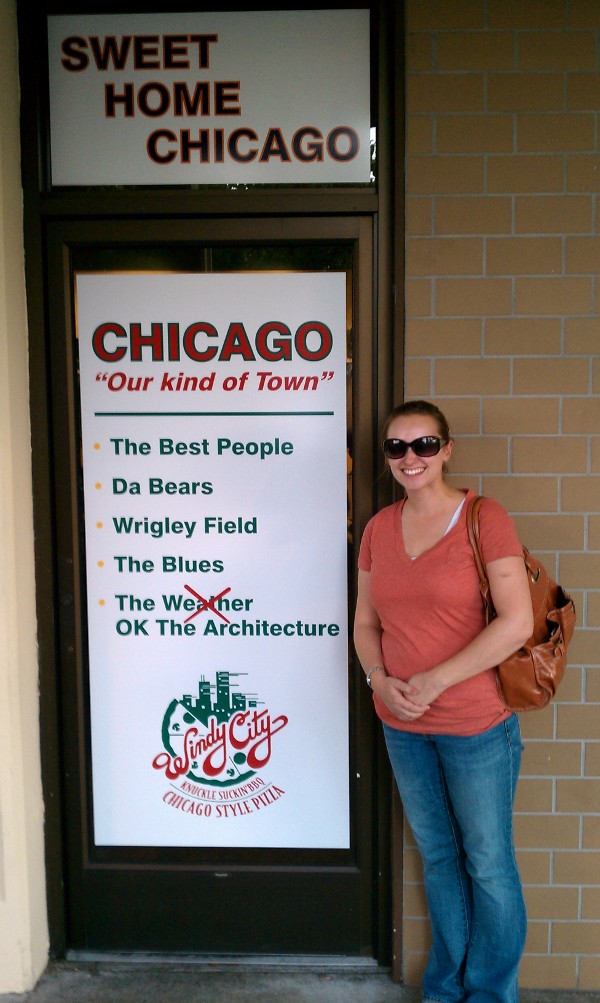
Windy City is a place I know pretty well. It’s located in San Mateo, which happens to be where I work, so it’s a frequent lunch destination. It was first suggested to me as a pizza place in response to my frequent gripe about the lack of any really good pizza in the Bay Area. More on the food in a bit, though.
 While San Mateo is a pretty central location for people coming from any direction, it’s not really ideal for any of them. There are two Caltrain stops in the city, but neither one is within walking distance of Windy City. It’s also far enough outside San Francisco that people who live in the city don’t usually want to venture down, and it’s a good 45-minute drive for people from San Jose. So central though it may be, it’s not exactly convenient for anybody. This is Windy City’s biggest strike against it.
Layout and Coverage 
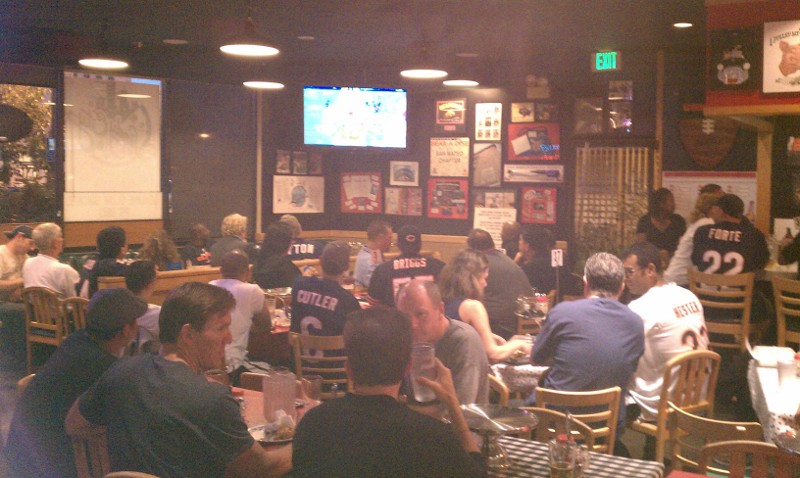 Inside, the feel is that of a family restaurant. There are lots of tables that all seem a bit too close together, and several booths in the back. The dining area is divided into two large sections: the primary area includes the bar and kitchen counter where you can order your food and drinks, and the secondary area has more seating for larger groups or families, as well as a few video games.
Windy City has recently upgraded their TVs from an outdated rear-projection screen to several wall-mounted LCDs, which is a welcome change. None of them are in ideal game-watching locations, but there are several TVs arranged throughout the dining area, making it easy to follow the game while you eat your meal. 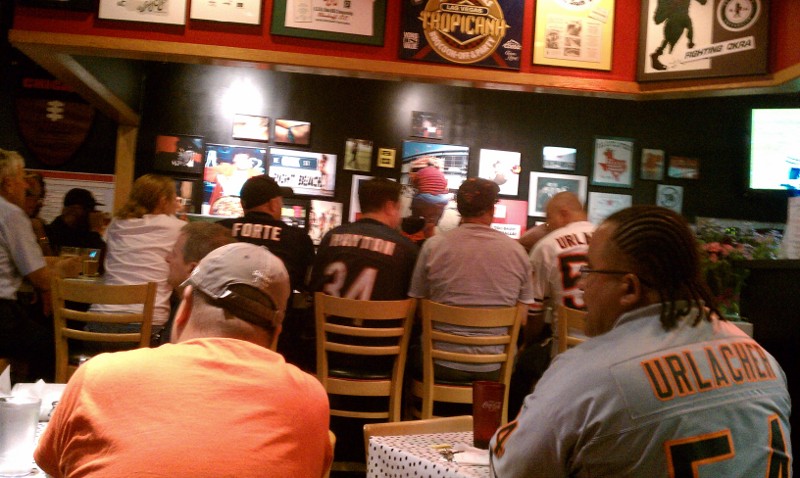 If you opt to sit at the bar—something only a dozen or so people can do at any given time—there’s a nice large screen behind it.
This being the “Bay Area home of the Chicago Bears,” the coverage focuses on the Bears game. I haven’t made the trek on a Sunday morning, so I can’t comment on their general gameday coverage, but in these two instances the nationally-televised Bears games were on every screen, as you’d expect.
Crowd 
The best part about watching a Bears game at Windy City is that it feels like home. Not only is the place filled with Bears fans, many of whom are sporting jerseys and other color-bearing apparel, but the majority of them are also transplants. You’ll hear a lot of Chicago accents here, and see some mighty mustaches that remind someone like myself of home.
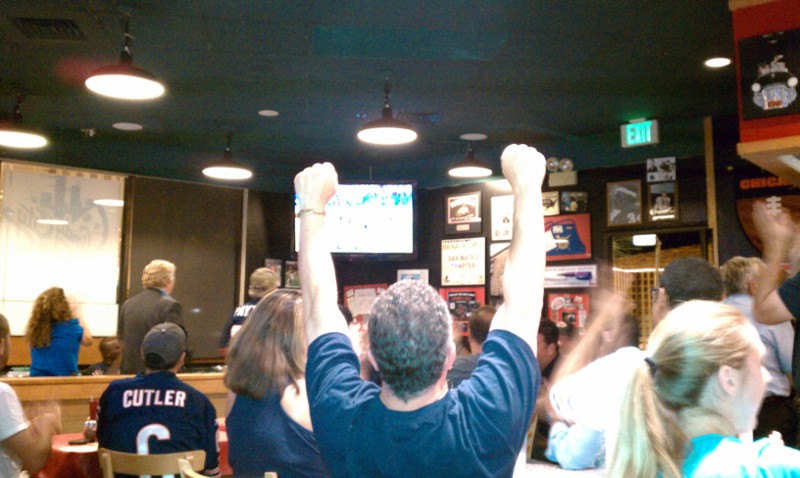 For Bears games, the crowd is rowdy and boisterous. They’ll cheer for the Bears and boo for the opposing team, as you’d expect, but they also add a nice touch: every time the Bears score, the whole crowd breaks out into a coordinated singing of “Bear Down, Chicago Bears,” with a ringleader holding up a sign with the lyrics on it to make sure everybody can participate. It’s a little bit of Soldier Field transplanted to San Mateo.
Food and Drinks 
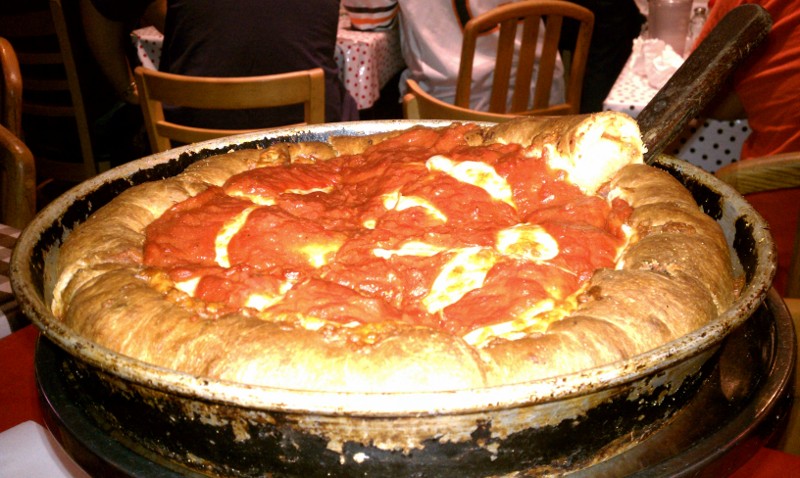 The food at Windy City is very good. They feature a mixed menu that’s half Chicago-style favorites and half Texas-style BBQ. The Chicago fare includes pizzas, beef sandwiches, and hot dogs, all of which are really close to what I would consider authentic, but not quite the same as what you’d actually get back in Chicago. Before getting into the pizza, though, I should make a special mention of the Italian beef sandwiches, which I sometimes get when we go here for lunch—it’s the only place outside of Illinois that I’ve ever seen actual giardiniera peppers, and they are spot-on.
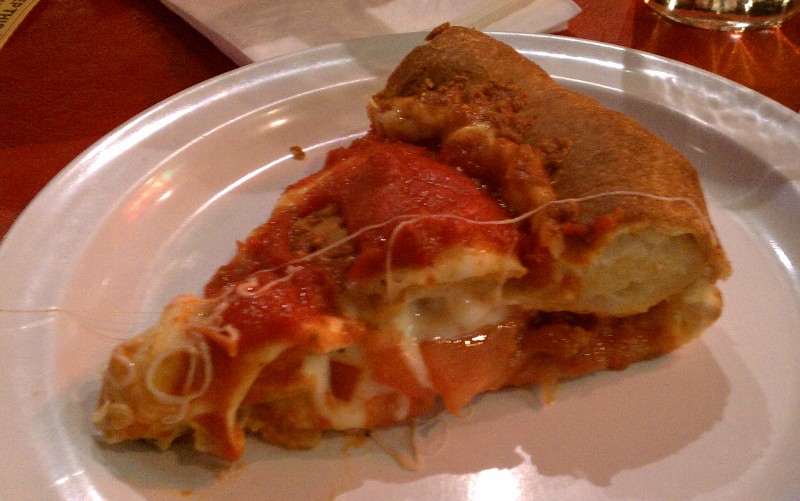
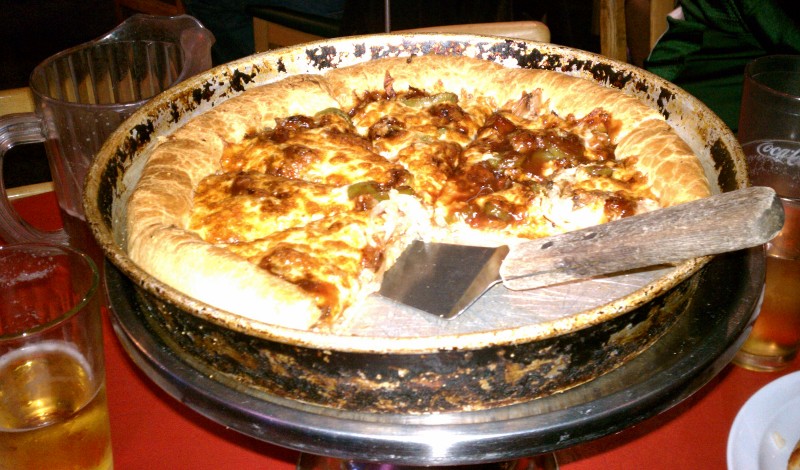 Both times we got pizza, as we almost always do. For week 3, we went with a ham/pineapple/onion/bacon deep-dish. For week 4, we actually considered going with a BBQ plate instead, but backed out because we like their pizza so much. So we split the difference and went with a pizza with BBQ pork. Both pizzas were awesome, as usual. The crust is extremely buttery and thick, and there’s ample amounts of cheese everywhere. The sauce is a little sparse, and they put it in rings on top of the cheese rather than completely covering it, but it’s pretty good as well. You can feed 4 people easily with a single medium pizza—2 slices is enough to fill anyone up, making the $25ish price tag quite reasonable.
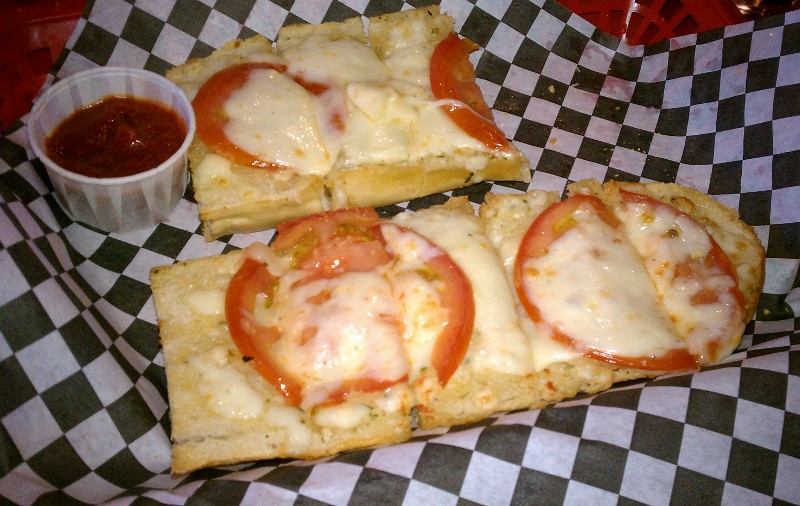 We also got some cheesy garlic bread as an appetizer, which is nice when you’re settling in for an entire game—and the pizza takes a good 45 minutes to cook anyway. The second time we added tomato slices to the bread, which made it even better.
The drink selection at Windy City is a little sparse, but decent enough. They typically have drink specials during Bears games, and for every trip to the bar you get a raffle ticket for various Bears merchandise. The downside to the beers—aside from somewhat of a lack of selection—is the price: we usually get pitchers for $14. That’s the regular price for Coors Light, or the “special” price for better beers during games (Kona Longboard or Stella Artois are our usuals). Still, though, you get frosted glasses to drink it out of, and the beer is always cold and the service friendly, and the prices are pretty typical of the area.
Intangibles 
One thing that perpetually annoys me is a place that can’t settle on an identity. You see this a lot with sports bars—they’ll claim to be the “official bar of” or the “home of” like 3 or 4 different (and unrelated) teams. Windy City falls into this category with their Chicago-slash-Texas motif. 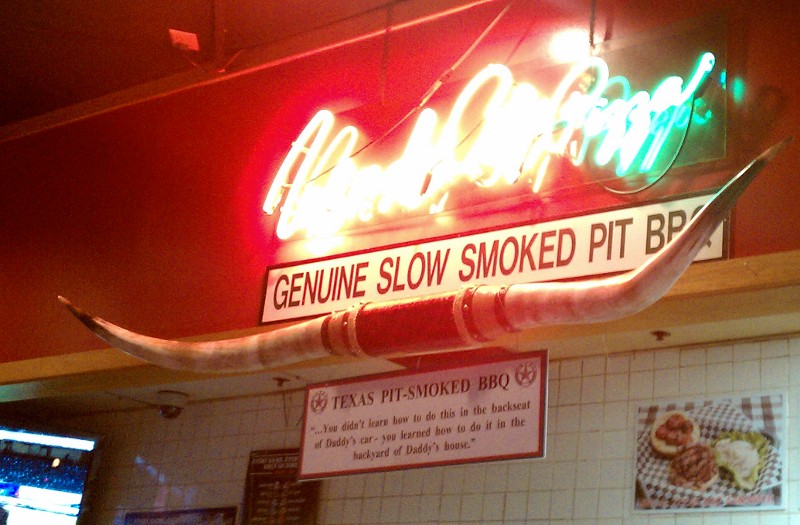 They’re mostly a Chicago place, not just with the food but also with the decor (lots of pictures of Soldier Field, Wrigley Field, and other recognizable Chicago venues). But then they also have this Texas sub-personality, like they weren’t willing to go all the way with the Chicago thing (or they thought it wasn’t enough). The BBQ always looks and smells good, but I’ve never tried it because I go here for Chicago-style pizza. I suppose it might be nice to have alternatives if you’re in a group and not everybody wants pizza, but it still doesn’t quite make sense to me. It’s like they’re not willing to go all-in with the Chicago thing, and that annoys me a bit.
The other missing piece comes in the game area. They have a few out-of-date arcade games, but if they were really a Chicago place, they’d have a Golden Tee machine. This is another thing that makes me think they’re not willing to go all the way with their Chicago persona.
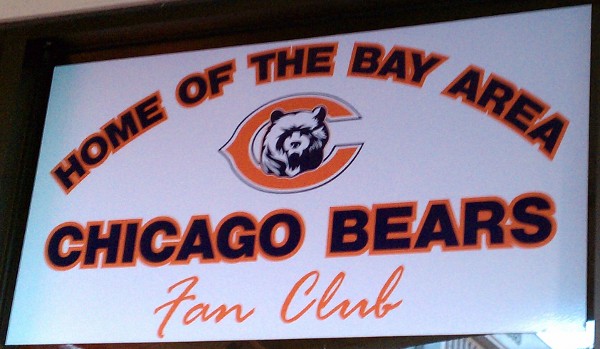
One nice touch is that Windy City is the home of the Bay Area Chicago Bears Fan Club. During games, the club is well-represented, and the president, a nice guy named Dave with one of those aforementioned mighty mustaches, is jovial and friendly. He does a good job organizing things, keeping the crowd involved in the game, and running an email list for Bears fans to commiserate on.
Summary
The atmosphere at Windy City is welcoming, the food is good, and it’s a great place to watch a Bears game. There are a few things they could do to complete the facade, but overall it’s a pretty respectable effort at capturing the feel—and taste—of a Chicago-style eatery. It’s a bit of a pain to get to, but it’s worth the trouble, especially during Bears games.
As it’s more of a restaurant than a bar, it’s not exactly the kind of place that could really become a hang-out, and that helps minimize the effects of the poor location. (It’s not like it needs to be convenient for daily happy hour visits anyway.) We haven’t fully judged it as an all-out Sunday NFL-watching destination, but for a change of pace during Bears prime-time games, it’s hard to beat.
| Location: | |
| Layout and Coverage: | |
| Crowd: | |
| Food and Drinks: | |
| Intangibles: | |
Comments Off on Bar Search Weeks 3+4: Windy City Pizza
I’ve got one thing to hang my hat on with my 2010 baseball predictions: I said that it’d be a year defined by pitching, and I think that held true. Mark Buehrle started the season off with an amazing play on opening day, and things only got better from there. We saw 2 perfect games this year, one in each league: Dallas Braden in the American and Roy Halladay in the National League. These were 2 of the 5 no-hitters thrown this year, the most in a single season since 1991. Interestingly, only two of these pitchers don’t have tee times right now (Halladay of the Phillies, and Matt Garza of the Rays).
And then, of course, there’s the perfect game that never was, thrown by Detroit’s Armando Galarraga. I think that kid gained a lot of fans, though, including myself; I was shocked and impressed by how classy he was in shrugging off an incident that would’ve sent countless other professional athletes into a childish foot-stomping fit. So really, there were 6 no-hitters thrown this year, though only 5 of them will count in the record books.
This is the kind of stuff you start to pay closer attention to when your team is clearly out of playoff contention nearly from the start of the season. You also look to find other gems—seeing #1 prospect Jason Heyworth’s debut with the Braves, for instance. Or you take an unreasonable amount of pride in the fact that Marlon Byrd won the All-Star Game (single-handedly, as I recall it) for the National League. Or you gain an interest in your team’s farm system, hoping to have something to look forward to in the future. After their annual trip to San Francisco in early August, though, I had little to keep me interested in the Cubs, and gradually stopped paying attention altogether as their roster looked more and more like their triple-A affiliate, the Iowa Cubs, than it did a big league team.
So maybe you start to follow another team. Living where I do, I go to a dozen or so Giants games a year as it is, only cheering against them when the Cubs are in town. (One of my favorite things to do is to go when the Giants are playing other NL Central teams, which I’m quite used to rooting against anyway.) As it happened this year, right around the time I was giving up on following the Cubs, the Giants began to make their playoff push. And as luck would have it, they went ahead and traded for a likable Cubs player in Mike Fontenot to make me feel like I had more of a connection. (Megan already felt the same way, since her former favorite Cub, Mark DeRosa, had been traded to the Giants last year—even though he missed this entire season with a wrist injury, we can still enjoy seeing him in the dugout.) It’s still not the same, mind you—3 years ago at this time I had tickets to watch post-season baseball at Wrigley, and while I’m really excited to attend some playoff games at AT&T Park, I know it won’t equal that experience. I’ll do my best to hold down my spot on the Giants bandwagon, though.
Fan Stats
For the reasons mentioned above and a few others, I didn’t follow the Cubs nearly as closely as I did last year. The good news is that the Fox Saturday blackout rules seem to have been relaxed, so I could watch day games on WGN even though my local Fox channel was carrying a nationally-televised game. The bad news is I didn’t take advantage of this as much as I would have in other seasons. The whole breakdown goes like this:
- I went to 2 games of the 4-game series the Cubs played in San Francisco
- I watched 84 games on TV
- Of these, 70 were thanks to the Extra Innings package
- Of those, I was able to watch the Cubs feed for 54 games
- That means I only had to watch the opposing team’s feed for 16 games
- There were 14 games I would’ve seen anyway, even if I didn’t spring for Extra Innings:
- 4 games I watched at a bar
- 4 games were televised on ESPN
- 6 games I got on my local channels
- Of these, 70 were thanks to the Extra Innings package
- I listened to 25 games on the radio
- Of these, 2 were on a local radio station
- I listened to only 4 games on XM in the car
- I followed 10 games at work via the MLB.com At-Bat program
- For 9 games, I went half-and-half between XM and MLB.com At-Bat
- Of the 51 games I missed entirely, they break down like this:
- 4 were due to the Fox Saturday blackout
- 1 was due to being at a Blackhawks game
- 15 were due to traveling, being on vacation, or having friends in town
- 3 were the fault of work getting in the way of a day game I would’ve otherwise followed
- And of course, particularly towards the end of the season, I missed 28 games out of complete indifference
So my “fan rate” this year was only a measly 68.5% (I followed, one way or another, 111 out of the 162 games). But then again, it’s not like the Cubs did a lot to earn my support this season. Their best month of the year was September, when they went 17-9, and I only paid attention to 6 of those games. So it goes.
Regular Season Reflections
My predictions were actually pretty good in the National League, as far as playoff teams go, at least: I had the Giants and Phillies winning their respective divisions, and pegged the Braves as the Wild Card team. I had the top two teams in the Central reversed, thinking the Reds would make a big jump this year but underestimating just how big it’d be.
In the American League, I didn’t fair nearly as well. The only playoff team I got correct was the Yankees, but I had them winning the East instead of the Wild Card. Their division went to the Rays, who I greatly undervalued. I had the Central jumbled up, picking the Twins to finish 3rd. I did the same thing with the Rangers in the West, a division I had almost completely upside-down.
So 4 out of 8 overall, which I suppose isn’t too bad. I’m pleased to find that for once, the league I follow more closely (the NL) was the one for which my predictions seemed to be more accurate. Maybe I’m learning.
Playoff Predictions
Having a fairly strong case of Giants Fever means it’s tough for me to objectively predict this year’s playoffs, but I’m going to give it a shot.
- ALDS:
 vs.
vs. 
I think the Rangers fall into the “just happy to have made it” category, though with their lineup they’re always dangerous. The Rays were the best team in the AL this year, so I don’t think they’ll have much trouble winning it in 4. - ALDS:
 vs.
vs. 
The Yankees seemed happy to settle for the Wild Card and a matchup with Minnesota, a team they’ve handled well in recent years, but I think home field advantage will prove to be the deciding factor in this series, and the Twins will take it in 5 games. - NLDS:
 vs.
vs. 
Like the Rangers, I think the Reds are a team that blew its load just to win their division. Also like the Rangers, they have a powerful lineup but a pitching staff that I can’t see carrying them through a Division Series. The Phillies are just too strong, and I think they’ll sweep it in 3. - NLDS:
 vs.
vs. 
While I’m glad that Derrek Lee gets to play in the post-season, I think that’s as far as he’ll get. The Giants won their division on the final day of the regular season against the one team they’ve really struggled against this year, so I think they’ll handle the Braves in 4 games. - ALCS: vs.
The Rays are strong, and they’ve been here before, but I think it’s the Twins‘ time to make it to a World Series. I’m giving them the edge in a tough 6-game series. - NLCS: vs.
If this series comes to be, it’ll be the highlight of this post-season. While I think the Phillies can never be counted out, I think it’ll be the Giants‘ pitching staff—particularly their bullpen—that can give them the pennant in a classic 7-game series. I said it’d be a year defined by pitching, and this series should end up being the pitching showcase of the year—though both teams have plenty of power at the plate, too. - World Series
vs.
I said at the start of the season that I’d much rather see a Giants-Tigers matchup than a repeat of last year’s Phillies-Yankees, and while I was wrong about the Tigers this year, a series between the Giants and the Twins would come pretty close (but of course Yankees-Phillies remains a possibility, too). I’m going to stop myself short of predicting the outcome; if this series happened, I’d likely be spending thousands of dollars to attend a couple of games, and thus would literally have too much invested in it. I’d actually give the Twins the edge on paper, but the emotional side of me says the Giants can put 4 games together out of 6 or 7.
Maybe some of this is wishful thinking, but it’s nice to at least have a vested interest this year. I don’t mind riding the bandwagon, especially if it means I get to see the World Series played in person.
The Cubs are totally positioned for next year, anyway.
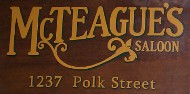
For week 2, we visited McTeague’s Saloon in what is generally considered Nob Hill, but it could also be the Tenderloin, or Civic Center/Downtown—it’s sort of right in the middle of the 3 (or 4) neighborhoods.
I’ve often said that Pete’s, our destination last week, is the only place in San Francisco that I’d consider to be a genuine sports bar. McTeague’s didn’t disprove that theory, but that doesn’t mean we didn’t enjoy ourselves.
Location
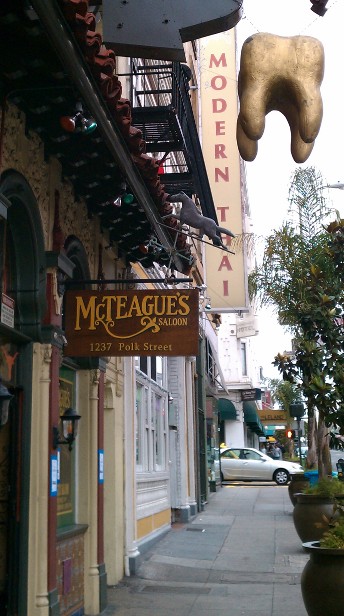 McTeague’s is sort of in a no-man’s-land of public transportation. We took the BART to the Civic Center stop, but that only gets you halfway there. Our options were then to take a 20-30 minute walk, ride a bus up Van Ness, or take a cab. Wanting to ensure that we arrived before kickoff at 10:00am, we opted for the latter option. (After football—and a full 5-6 hours of drinking—to get home, we didn’t mind walking back to the BART stop.)
While it was a little less than convenient to get to, especially for those of us coming from outside of the city, once we arrived in the neighborhood McTeague’s started to score points. On and around the same block of Polk Street are multiple other bars, small restaurants, and quaint little shops. The biggest disappointment from the surroundings came when we found that the crepes place across the street was closed.
Layout and Coverage
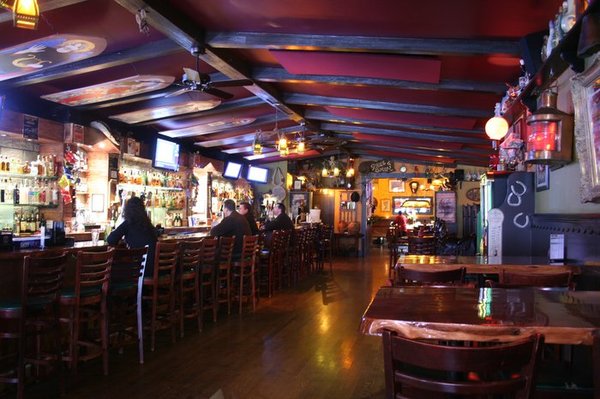 McTeague’s is not very well laid-out for NFL Sundays. As you walk in, on the left is the bar, with several modest-sized LCD TVs above it, and on the right are tables and chairs. In the rear is a separate back bar, with a couple more TVs—two fairly large ones in the corners and two small ones behind the bar—as well as a couple of tables in the middle. This is where we situated ourselves.
They do have Sunday Ticket, and make a token effort to have all of the games on. When we settled in the back area, the bartender took notice of our attire (most of us are Bears fans, but this week one of our party was a Cowboys fan) and put the Bears-Cowboys game on one of the larger screens for us. Being in the smaller back bar, we were only able to keep tabs on 3 other games besides the main one we were watching, but they did have other games on out in the main bar area.
There were a couple of problems with the game coverage. First, as the Bears game was the local Fox game of the week, it was blacked out on the Sunday Ticket channel. It took a few minutes to locate the bartender and get him to change the channel once the game had started. This seems like something the employees and the establishment should be more on top of. Then, during the first half, a guy came in who seemed like he owned the place and started changing the channels around. He eventually put our game on the other of the two large screens, but it was annoying nonetheless. I feel like if he had a strong preference on which games were on which screens, then he should be there prior to kickoff. Otherwise, don’t screw with the TVs while your customers are watching them.
Finally, at one point it seemed that the DirecTV feed went out, and all of their receivers reset themselves. This is something I’m all too familiar with, unfortunately; whether it was the bar’s fault or not I can’t say, but it resulted in 10 minutes of nothing to watch on any of the screens in the middle of the second half of the early games.
Crowd
Part of the reason we chose to go to McTeague’s this week was because the Bears were playing the Cowboys, and this is sort of a Texas bar. We thought it’d be fun to go into enemy territory, as it were.
While there were a handful of Cowboys fans there, it was clear that this wasn’t a big place to watch Cowboys games, which we found disappointing. (McTeague’s is a University of Texas bar, it turns out—they have Longhorns signage all around, and apparently having Texas fans doesn’t necessarily translate into also having Cowboys fans.)
By the second quarter of the game, though, the crowd had filled in, and was a fairly rowdy bunch. Many people gathered in the back area where we were sitting, standing around to watch the games that were shown there. We had some fun back-and-forth with one particularly boisterous Cowboys fan, which was exactly what we were looking for. The poor layout of the bar in general made it difficult to get to the bathroom or to go outside during commercials, but the fun in this whole endeavor comes from sharing in the football-watching with strangers, and we did accomplish that.
Food and Drinks 
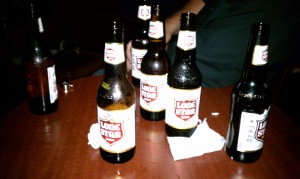 The good thing about McTeague’s being a Texas bar is that they serve Lone Star beer. Not because the beer is any good, but because it’s $2 all day every day, which suited us quite well. Additionally, on NFL Sundays, they have Coors Light bottles for $2. Between the two, we were well-covered in terms of being able to drink beer all day without spending much money.
They also had some pretty cheap food specials. These, too, weren’t exactly what I’d call “good,” but for the money they were a good deal. $2 tacos is the special for football, so that’s what we went with. We also got a plate of nachos for the table. The best part of this meal was the nacho cheese sauce on the nachos: it was that kind of unholy glowing-yellow sauce that you normally find in a convenience store, except it was more creamy and thus even better. The tacos were serviceable; they were filled with a good amount of meat (most of us got pork, as they were out of steak), although there was no cheese on them, which I found disappointing.
The theme of the food and beverages seemed to be “low-class,” which fits with my mental stereotype of a Texas-style bar, but also fits well with my propensity to over-indulge. We definitely spent significantly less money than we did in week 1, and that’s a good thing.
Intangibles
 The #1 reason McTeague’s was high on my list of places to visit is because it’s named after the seminal 1899 Frank Norris novel
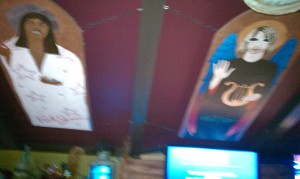 The decoration gets a little weirder, though. Behind the bar, hanging from the ceiling, are hand-painted coffin lids of deceased musicians and other figures (such as Hunter S. Thompson). I took an admittedly blurry picture of the Rick James and Kurt Cobain coffin-tops, which you can see at left, but you can see a couple of better examples at Yelp (Cobain and Thompson, for instance). I didn’t get an explanation for these. They seem to be somebody’s art project, and the collection is pretty random, other than the fact that most of them are musicians (another one I recall was Janis Joplin).
While the bar itself was nice enough, and fairly clean, the bathrooms were dingy and not well-kept. They did have paper towels, at least. Like the rest of the bar, they weren’t very well laid-out, making for a couple of awkward moments. On the plus side, the restrooms were located in the back near the rear bar where we were seated, so we had easy access to them.
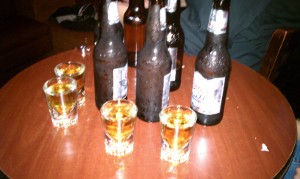 The best option when spending a whole day in a bar is to befriend the bartender, and while we were focused on the games and didn’t spend a lot of time chatting, we definitely got on the good side of ours. He commented multiple times on how we were his “best drinkers” that day, which I suppose is a complement. We’ve definitely found that our Midwestern enjoyment of excuses to drink during sunlight hours is not something you commonly find out here. While this means it’s harder to find people to join us in such endeavors, it does have the upside of making our antics seem a bit more impressive and unusual. So I guess we stand out. At any rate, during the later games, the bartender offered to buy us a shot, and poured them generously. I selected Jameson, and you could say that we enjoyed it.
Summary
We found McTeague’s to be a decent bar, although nothing special. For NFL-watching, it’s definitely not ideal, but we made do. When we arrived, they still had EPL games finishing up, and apparently it’s a good soccer bar in general. Our friends said that it’s a place they’ve enjoyed on many a Friday or Saturday night, but we found that for Sundays it’s not the best. Still, we had a good time, and I’m glad to have seen it.
Next week, as the Bears play on Monday Night Football, we’re going to do something a little different. We’ll take Sunday off, and I’ll actually try to get my money’s worth out of the Sunday Ticket package.
| Location: | |
| Layout and Coverage: | |
| Crowd: | |
| Food and Drinks: | |
| Intangibles: | |
This is our third NFL season spent in the Bay Area, so we’ve decided it’s time to get out of the house a bit and find the ultimate San Francisco football bar at which to watch games on Sundays. Megan and I, along with some friends, are planning to spend each Sunday this fall exploring a different bar, and I’m intending to report on and rate each one. Our primary goal is to find a Bears bar, but we’re open to anything that makes for a good place to watch football in general.
Being as this was opening week, we didn’t want to stray too far into the unfamiliar while establishing our new Sunday routine, so we stuck with something we know: Pete’s Tavern in Mission Bay, right across the street from AT&T Park. Pete’s is familiar to us not only as a favorite Giants pre- and post-game hangout, but also because 66% of our group (two of the three couples) lives in the Avalon apartments just a couple of blocks away.
I’ve devised a set of 5 criteria that I’ll use to judge the places we visit: Location, Layout and Coverage, Crowd, Food and Drink, and Intangibles. This being week 1, I’ll explain what I mean by each of these along the way. Because I’m lazy, I’m using the same star ratings here that I use for my movie reviews, but obviously my explanations don’t apply here; what’s important to know is that it’s a 4-star scale.
Location 
There are two main factors that contribute to my judgment of how good a bar’s location is. First, since Megan and I live outside of the city, and because we’re going to be spending all day drinking there, it needs to be accessible by public transportation. Second, it needs to be in a good neighborhood; by this, I don’t mean an area without much crime (although that’s nice too), I mean somewhere with a lot of like-minded people, as well as other options for bar-hopping in case our primary choice doesn’t suit our needs. Having options for places to eat in the vicinity is a plus, too.
Pete’s is conveniently located 2 blocks away from the 4th and King St Caltrain stop. This makes it really easy to get to for those of us coming from outside of the city. The only downside is that the Caltrain only stops in South San Francisco (where we’re coming from) once an hour, so in order to arrive in time for kickoff, we have to catch the train at 9:08am. While this makes for an early morning, it puts us at the bar in time for them to open the doors at 9:45am.
The neighborhood is a little lacking in other options, but Pete’s is a known quantity, and when we go there the odds of having to come up with a backup plan are low. So it mostly gets a pass on this point, even though if we chose to leave Pete’s and go somewhere else, it’d likely involve a short cab ride.
Layout and Coverage
Being as our primary purpose here is to watch football—and given that I’m wasting the $300 I spend annually on Sunday Ticket by going to a bar in the first place—any location we try has to have every game on. This means they must have many TVs, they better all be HD, and they need to have a barstaff that’s savvy enough to make sure every game is viewable. (I can’t tell you how many bars I’ve been to in the Bay Area where the employees have no idea how to find a game on TV when requested—never mind that a true sports bar should preempt the need for such a request in the first place.) On NFL Sundays, the more games I can see at once, the better—I’ve got a lot of fantasy players and various bets that need monitoring.
Pete’s has a fantastic setup for watching sports in general. They have two huge projection screens, and several large LCDs well-distributed throughout the bar. Everything is in HD. The horseshoe shape lends itself well to providing good viewing angles for several screens at once. They have Sunday Ticket, and their bartenders are knowledgeable sports fans who know enough to make sure that every game is on at least one screen.
They get docked points for only having a single TV with the Bears game on it, despite our group’s protestations to the contrary. They chose the Patriots-Bengals game to get the primary projection screen and the PA system, which I found to be a surprising selection, but not necessarily a bad one. Most other games were on two screens at opposite sides of the room, meaning everybody present had a pretty good chance of being able to see the game they most wanted to watch.
They also have a sizable upstairs area with additional screens, but this was blocked off for a 49ers party (which, presumably, started around 1:00pm). By the time the afternoon games rolled around, I didn’t notice whether anybody was up there or not, but for the first 3 hours we were there it definitely seemed like a waste of space.
Crowd
A good football bar crowd is hard to find: there’s a fine balance that must be achieved. It’s fun to have representatives from many teams present, and in a city like San Francisco where there are so many transplants, this part is almost a given. While it’s enjoyable to have people rooting for every team (or close to it), you don’t want any one group of fans to overpower the others, unless you’re at a place that explicitly identifies itself as a bar for that team’s fans. As far as capacity goes, while half the fun of going to a bar to watch games is experiencing NFL Sunday with strangers, I don’t like the place to be too packed. A good layout has a lot to do with this, too, but a place that packs people in is going to get docked significantly—as is a place that tends to attract overly-boisterous assholes.
Being right across the street from AT&T Park, Pete’s is in an area that tends to live and die by the baseball season, and more specifically the Giants’ schedule. Since the Giants were in San Diego this weekend, there wasn’t a lot going on around the ballpark when we arrived. A small crowd (maybe 15 people) was gathered out front waiting for the doors to open, so we were able to have our pick of seats at the bar without having to feel like we were the only ones ordering beer in public at 10 o’clock in the morning.
We were pleasantly surprised by the number of Bears fans who filed in, taking up a large table on our side of the bar. This gave them a great view of the single TV dedicated to our game, but it also made the decision by the barstaff to not put the game on another screen more questionable. There were even a few Detroit fans there, and yet for some reason our game got the same status as the Miami-Buffalo game (which I’m pretty sure nobody was actually watching, aside from the occasional check on fantasy and gambling implications it might’ve had).
There were fans from several other teams, as is to be expected, and they were all courteous and friendly from what I saw. The overall ambiance was that of a general-purpose football party. I’m sure being the first week of the season has something to do with this, since nobody (other than Saints fans, maybe) has much justification to be overly cocky or boisterous. Still, though, the crowd was consistent with what I’ve seen every time I’ve been to Pete’s: passionate sports fans who are nonetheless fun to be around, even if they’re rooting for a different team than you.
Food and Drinks
As it’s a bar we’re going to, it should come as no surprise that we’re there to drink. Well, watch football, and drink. It’s really a 1a-1b situation, and I’m not sure which is which. So having a good selection of drinks—beer in particular—is important. Being a Midwesterner, I’m partial to Miller Lite. I think the old “Great Taste/Less Filling” slogan rings true: it tastes good, and I can drink it all day. But on the West Coast it’s sometimes hard to find my beer of choice, so that’s a big criteria for me. Cost is also a consideration, but this being San Francisco, it’s pretty safe to assume that everything will be expensive. Additionally, since we’re going to be there for several hours, food is an important factor. We’re most likely going to be looking for bar food, but quality bar food, and the service needs to be acceptable. Price is a consideration here as well, naturally.
Pete’s scores high marks on all counts. They have somewhere in the neighborhood of 20 beers on tap, and many more available in bottles. Most beers are about $4, including Miller Lite (which they only have in bottles). This is surprisingly reasonable for the area (across the street during baseball games, you’ll pay $8.25 for a pint). They were also serving mimosas, the breakfast drink of choice for many, and while our party didn’t order any of these, many people around us did, and all seemed to really enjoy the option.
The food is fantastic. On Sunday mornings, Pete’s offers breakfast, and everybody I saw opting to go this route did not regret it. I had the huevos rancheros, and it was probably the best such plate I’ve ever eaten. They deep-fry the tortillas, making it a sort of breakfast-Mexican pizza. It was awesome. Megan waited a little longer and got the Western burger, which she reported was also terrific—and its grilled-beef smell was enjoyed by everybody in her immediate area, too. For additional dining options, there’s also the adjoining cantina (owned by the same people), Pedro’s. (The two establishments are connected, which has the added benefit of providing twice the restroom capacity.) Prices on food are quite reasonable; the average meal was about $10-11.
Intangibles
This category is for anything that’s not covered by the other four already mentioned above. It can include anything from quality of bartenders to cleanliness of the bathrooms.
In terms of intangibles, Pete’s can’t be beat. Partially due to the fact that the others in our group are regulars, but also simply as a general manner of course, we got impeccable service. The six of us sat at the bar and were never wanting for drinks. Our bill was surprisingly low when we finally left around 4 in the afternoon, and we had fun bantering with the ladies behind the bar the whole time we were there. They’re welcoming and friendly, and they know their sports.
Due to the NL West playoff race going on, there was a nice segue from the early football games into the Giants-Padres game, which got equal screen estate with the 49ers-Seahawks game. The crowd and atmosphere adapted into a decidedly San Francisco setting in the afternoon, and it’s fun to enjoy the games with the hometown fan base.
The final point in Pete’s favor is their bathrooms: while they’re downstairs, making for potentially dangerous stumbling on your way there and back, they’re extremely clean and have plenty of capacity. Whenever I’m at Pete’s, I find myself surprised and impressed by the clean, glistening chrome-handled sinks, and the preponderance of high-quality paper towels on and around them. It’s things like this that really make for a comfortable and enjoyable bar experience for me.
Summary
I already knew Pete’s as a great place to watch games, and NFL games are now included in that reputation. They have lots of screens and they know how to use them, the crowd was just about right, and the food, drinks, and service were all great. They’re not going to be our Bears bar of choice, but as a general-purpose football-watching bar, Pete’s is a definite winner.

| Location: | |
| Layout and Coverage: | |
| Crowd: | |
| Food and Drinks: | |
| Intangibles: | |
Comments Off on Bar Search Week 1: Pete’s Tavern
Another NFL season is upon us, so it’s time to get my predictions out. This has become sort of my “psyching-up routine” (along with my annual “big league” fantasy draft). My picks from last year weren’t too far off for the regular season, although once again I was better on picking the AFC than I was with the NFC, which is weird because I watch far more NFC games. (This could, of course, be taken as yet another example of the theory that the more one thinks one knows about sports, the less one actually knows.)
For playoff teams, in the AFC I got 3 out of 4 of the division winners correct (New England, Indianapolis, and San Diego), and 1 out of the 2 Wild Card teams (Baltimore). 4-for-6 isn’t too shabby.
In the NFC, however, I only picked one division winner correctly (New Orleans), although I had the two NFC East playoff teams (Dallas and Philadelphia) picked, I just had their finishing order reversed. So only 3-for-6 in the NFC.
And of course, both of my Super Bowl teams—Philadelphia and San Diego—lost their first playoff game last year.
Time to see if I can do better. Here are my predictions for final standings and records, with playoff teams and winners in bold as usual.
 |
|
|---|---|
| North | South |
| Cincinnati 11-5 | Tennessee 11-5 |
| Baltimore 10-6 | Indianapolis 10-6 |
| Pittsburgh 9-7 | Houston 9-7 |
| Cleveland 5-11 | Jacksonville 4-12 |
| West | East |
| San Diego 10-6 | Miami 11-5 |
| Denver 9-7 | New England 9-7 |
| Kansas City 7-9 | New York 8-8 |
| Oakland 4-12 | Buffalo 2-14 |
| AFC Championship | |
| Cincinnati | |
| over | |
| Tennessee | |
 |
|
| North | South |
| Green Bay 12-4 | New Orleans 13-3 |
| Minnesota 9-7 | Atlanta 10-6 |
| Chicago 6-10 | Tampa Bay 9-7 |
| Detroit 4-12 | Carolina 4-12 |
| West | East |
| San Francisco 10-6 | Dallas 14-2 |
| Seattle 7-9 | New York 9-7 |
| Arizona 4-12 | Philadelphia 7-9 |
| Saint Louis 3-13 | Washington 6-10 |
| NFC Championship | |
| Dallas | |
| over | |
| New Orleans | |
Super Bowl XLV |
|
| Dallas | |
| over | |
| Cincinnati | |
Also as usual, I have a few thoughts to add to the above:
- I think Indianapolis will have a hard time overcoming the Super Bowl losers’ hangover, but they’re one team that should be able to do it.
- While Seattle really has none of the requisite pieces to win more than about 2 games in a season, don’t underestimate the New Coach Factor. They’ll surprise, but only a little.
- The NFC West is really San Francisco’s to lose. This team reminds me a lot of the 2006 Bears: great defense, solid running game, good enough offensive line and receivers to overcome a nobody quarterback. And no other team in the division has any business sporting a winning record by season’s end.
- I think it’s time for Brett Favre to go out with a whimper, and I’m looking forward to seeing it. I’ll give him enough credit to believe that he can will the Vikings into the playoffs, but no further.
- It won’t surprise me if Dallas becomes the first Super Bowl host team to win the Lombardi trophy at home. But it won’t surprise me if they find a way to squander all of their talent, either. Again.
- Coaches potentially on their farewell tours this year: Lovie Smith (Bears), Tom Cable (Raiders), Jack Del Rio (Jaguars), John Fox (Panthers), and maybe Josh McDaniels (Broncos).
- I know it’s blasphemous to pick the Patriots to miss the playoffs, but they are just old at this point, so I figure something’ll happen to ruin their perennial hopes.
- While I think the Saints and Cowboys will dominate the NFC, the AFC seems much more wide-open this year than it has been in recent seasons. Of course, I’m probably wrong on both accounts… as usual.
I’ve heard it said that at the start of every baseball season, each team knows they’ll win 60 games and lose 60 games—it’s what happens with those other 42 that determines how the season will be remembered. I find this to be somewhat of a comforting thought, and one of the things that separates baseball from the other professional sports leagues. They play almost every day for nearly 6 months; there’s always a chance to turn things around, to go on a winning streak, to catch your rival in the standings.
2010, I think, will be a year defined by pitching. I don’t see a lot of really strong offensive teams, other than in the AL East, but I do see a lot of freshly-bolstered pitching staffs and teams betting that that’ll be enough to carry them to a division title. I’m inclined to agree, and my picks below reflect this.
| NL West | NL Central | NL East |
|---|---|---|
| Giants | Cardinals | Phillies |
| Dodgers | Reds | Braves |
| Rockies | Cubs | Nationals |
| Diamondbacks | Brewers | Mets |
| Padres | Astros | Marlins |
| Pirates | ||
| AL West | AL Central | AL East |
| Mariners | Tigers | Yankees |
| Angels | White Sox | Red Sox |
| Rangers | Twins | Rays |
| A’s | Indians | Orioles |
| Royals | Blue Jays | |
Of course, if it’s a season defined by pitching, that also means it’s one that’ll likely be defined by injuries, so I’m not all that confident that my predictions here will be any better than they were last year. As always, though, I’m excited to find out.
I think this’ll be a season with quite a few surprises, so while I’m inclined to say that the front-runners for the World Series would be the Phillies and the Yankees (a rematch of last year’s Series), I don’t actually think that’ll be the case. Looking at my playoff teams above, though, those are the only choices that I don’t think would be a stretch at this point. I think a Giants-Tigers Series would be much more fun to watch, personally. It’ll be interesting to see if things can shake out that way.
Comments Off on MLB 2010 Predictions
Fan Stats
Last year, I claimed that I watch about 130 Cubs games a year, and listen to another 25 or so. After writing that, I got curious as to what the actual numbers were, so this past season, I kept track. I present here, then, my personal “fan stats” for the 2009 season. Of the 161 games my team played, I followed 143 of them (for a “fan rate” of 89%, a bit less than the 95% I’d estimated last year—though, I think somewhat understandably, I was more interested in the team last year than I was this year). The breakdown of the games I followed goes like this:
- I watched 116 games on TV, most thanks to the MLB Extra Innings package
- I listened to 20 games on XM radio, either at work, at home, or in the car
- For 2 games, I watched half on TV and listened to the other half in the car on XM
- I listened to 2 games on AM radio while driving between Chicago and Champaign
- I attended 3 games: one in Chicago, and two in San Francisco
And the games I missed can be summed up like so:
- I missed 8 games due to the Fox Saturday monopoly on baseball and the resultant blackouts (this number would’ve been higher, but I sometimes listen on XM on Saturdays while working on something around the house)
- I missed 5 games due to being on vacation, traveling, etc (including one on my wedding day—although I was able to catch a couple of innings backstage before the big event got underway)
- I missed 2 games because my DirecTV DVR randomly screwed up recording them, for no apparent reason
- I missed 3 games towards the end of the season, when the Cubs were eliminated from playoff contention, out of sheer indifference
I don’t know if anybody besides me finds this interesting or not, but I’d love to hear similar “stats” from other fans. If you’re a baseball fan, consider keeping track of how you follow your team for the 2010 season—I’d love for you to share the results with me here at the end of next season. (I just kept a text file in my home directory, and added a line for each game; the summaries above are then easily obtained by using grep.)
Regular Season Reflections
My pre-season predictions were quite a ways off the mark this year. I went out on a limb where I shouldn’t have, and didn’t stick with what I should’ve known in too many cases. I only picked 2 correct playoff teams in the AL, and 1 in the NL. Here’s a brief division-by-division summary of how the season went:
- NL West: I had the Dodgers picked to win the division, and they did. I also correctly picked the NL Wild Card to come out of this division, and the Giants almost proved that you can do that with pitching alone, but not quite. Instead it was the Rockies who took the last NL playoff spot (and they actually contended for the division title, but finished 3 games behind LA).
- NL Central: My “third time’s a charm” mentality for the Cubs didn’t pan out, as their off-season moves proved to be as damaging as they could’ve been. The Cardinals led the division for most of the year, with the Cubs only briefly sniffing at first place before trailing off quietly.
- NL East: I was probably more wrong about the Mets than any other team, who were mostly out of it right from the start. The Phillies rode the momentum of their World Series win from last year for another strong season. I also underestimated the Marlins, who ended up being somewhat involved in the Wild Card race.
- AL West: I couldn’t have been more wrong about the Angels, who cruised to another division title. The Rangers did, as predicted, make a push, but it wasn’t nearly enough.
- AL Central: The White Sox were never truly in the race, instead giving way to the Twins and Tigers to play a 163rd game to decide the division (the second year in a row for the Twins, this time with better results).
- AL East: While I had the Yankees taking the Wild Card, I completely underestimated their ability to rebound from a thoroughly disappointing season last year. Instead they were the best team in baseball, winning 103 games and walking away with the division. The Red Sox did take the Wild Card.
I suppose the one thing to hang my hat on was picking the two divisions that the Wild Cards came out of, meaning my judgment of the 6 MLB divisions as a whole wasn’t very far off, even if my appraisal of the individual teams proved to be less than accurate.
Playoff Predictions
I said before the season started that I thought it’d be the Dodgers over the Red Sox in the World Series, and while that still remains a possibility, I’m not so sure how likely it is. Here are my picks for the round-by-round playoff matchups:
- NLDS:
 vs.
vs. 
The Rockies finished the season strong, but the Phillies are more experienced and have the home-field advantage. I think it’ll be a close series, but the Phillies will take it in 5. - NLDS:
 vs.
vs. 
The Dodgers really seem to have backed their way into the playoffs, while the Cardinals have only been looking stronger and stronger the second half of the season. I think they’ll win it in 4. - ALDS:
 vs.
vs. 
The Twins are likely happy just to have snuck into the postseason, but I think they’ll have enough momentum to win a game and avoid the sweep. The Yankees are just too strong all around, though, and they’ll win it in 4. - ALDS:
 vs.
vs. 
Is this the year the Angels finally get past the Red Sox in the playoffs? Don’t count on it. I think it’ll be yet another sweep. - NLCS: vs.
The Phillies had a great run last postseason, but the Cardinals are a team you can never count out in October—I’m just not sure if it’s because of, or despite Tony La Russa. Either way, I think they take the series in 6. - ALCS: vs.
In this familiar match-up, I think the age of the Red Sox will give way to the new-look mix of youthful talent and proven veterans that the Yankees field. It wouldn’t be baseball if a Sox-Yankees series didn’t go the distance, though, so I’m predicting it to take all 7. - World Series: vs.
The Yankees have been the dominant team in baseball all season, and with their pitching staff, well-rounded lineup, and home-field advantage, I think they’ll ride it all the way to a championship. The Cardinals will put up a bit of a fight, but not enough to get past game 5.
If the above predictions hold true, I won’t be watching very closely. That’s pretty much a summary of how I’ve felt about the whole 2009 season, though, so it’d only be appropriate.
Last year I was 3-for-6 in picking AFC playoff teams, and only 2-for-6 with the NFC, but I did get two of the four participants in the conference championship games correct (although I was off on the Super Bowl matchup). I think this year might hold just as many surprises as 2008 did.
Once again, I’m not picking every single game, so the wins and losses might not add up quite right, but they’re more meant to give my general feel for each team (e.g., the Bears “feel about like” an 11-5 team to me this year). My total number of wins and losses league-wide (256-256) do add up, though.
So here are my picks for the impending 2009 NFL season, with playoff teams and winners in bold.
|
|
|---|---|
| North | South |
| Pittsburgh 12-4 | Indianapolis 11-5 |
| Baltimore 10-6 | Tennessee 10-6 |
| Cincinnati 8-8 | Houston 6-10 |
| Cleveland 4-12 | Jacksonville 5-11 |
| West | East |
| San Diego 13-3 | New England 12-4 |
| Denver 8-8 | Buffalo 10-6 |
| Kansas City 4-12 | Miami 5-11 |
| Oakland 3-13 | New York 4-12 |
| AFC Championship | |
| San Diego | |
| over | |
| Pittsburgh | |
|
|
| North | South |
| Chicago 11-5 | New Orleans 10-6 |
| Minnesota 8-8 | Tampa Bay 8-8 |
| Green Bay 7-9 | Atlanta 7-9 |
| Detroit 2-14 | Carolina 6-10 |
| West | East |
| Seattle 11-5 | Philadelphia 13-3 |
| San Francisco 9-7 | Dallas 10-6 |
| Arizona 9-7 | New York 9-7 |
| Saint Louis 4-12 | Washington 7-9 |
| NFC Championship | |
| Philadelphia | |
| over | |
| Chicago | |
Super Bowl XLIV |
|
| San Diego | |
| over | |
| Philadelphia | |
A few notes, tidbits, and further thoughts on the above:
- I’m taking the Chargers again this year—they just seem like they’ve been poised for a big breakthrough season for a few years now, plus they’re the most stable team, both in terms of their roster and their coaching staff.
- It probably goes without saying, but never count out the Patriots, Steelers, or Colts. They’ve been the most consistently dominant teams of this decade.
- Remember how the Dolphins won the AFC East last year? Neither do I.
- Ditto for the Panthers in the NFC South—although that division is wide open again this year, so none of the four teams winning it would surprise me.
- I could see both NFC Wild Cards coming out of the same division: either the East or the West. I split the difference in my picks, though, and went with one from each.
- It wouldn’t surprise me if I’m wrong about the Vikings—while my disdain for Brett Favre might be clouding my judgment, the Vikings do have more tools surrounding him than the Jets did last year, but I’m still fairly confident that he’ll find a way to disappoint yet another fan base.
- Speaking of Minnesota, am I the only one who was surprised they didn’t make a play for Michael Vick after Favre initially told them he was going to stay retired? It seemed to me like he would fit into their offense well, taking the lead in place of Tarvaris Jackson, but as far as I know they made no effort to sign him. Instead he’s now yet another weapon on the Eagles’ already high-powered offense, which I think will be the class of the NFC.
- Jay Cutler gives the Bears the same kind of spark they had in 2006 with Rex Grossman when he was on his game, if he can play up to his potential. Here’s hoping.
One of the things I’ve found (to my pleasant surprise) that I enjoy about having the MLB Extra Innings package on DirecTV is that I get to watch a lot of baseball games with other teams’ announcers calling the plays. While the quality of the commentary varies widely—particularly in regards to the hometown bias factor—it’s kind of nice to watch some games from the other team’s point of view. I also get a nice sampling of what kinds of coverage and commentary there are around baseball. A lot of the time this gets annoying, though, especially with some of the smaller-market teams, which aren’t able to attract (and pay for) quality announcers.
In the NL Central, which is the majority of the baseball that I end up watching, the Cardinals, Pirates, and Reds tend to have announcers that shade more towards the “hillbilly fan” end of the spectrum, while the Cubs, Astros, and Brewers have guys who come across more as professional broadcasters in their booths. In the case of the Cubs and Astros, I think this is because they’re major-market teams; in the case of the Brewers, it’s because they have Hall of Fame announcer Bob Uecker calling the plays, who’s one of the best around. While I’m obviously preferential towards Len and Bob—I think they provide a tasteful amount of home-team favoritism while still keeping things professional, although they are occasionally a bit dry—it’s surprisingly fun to give some of the other announcers a listen from time to time.
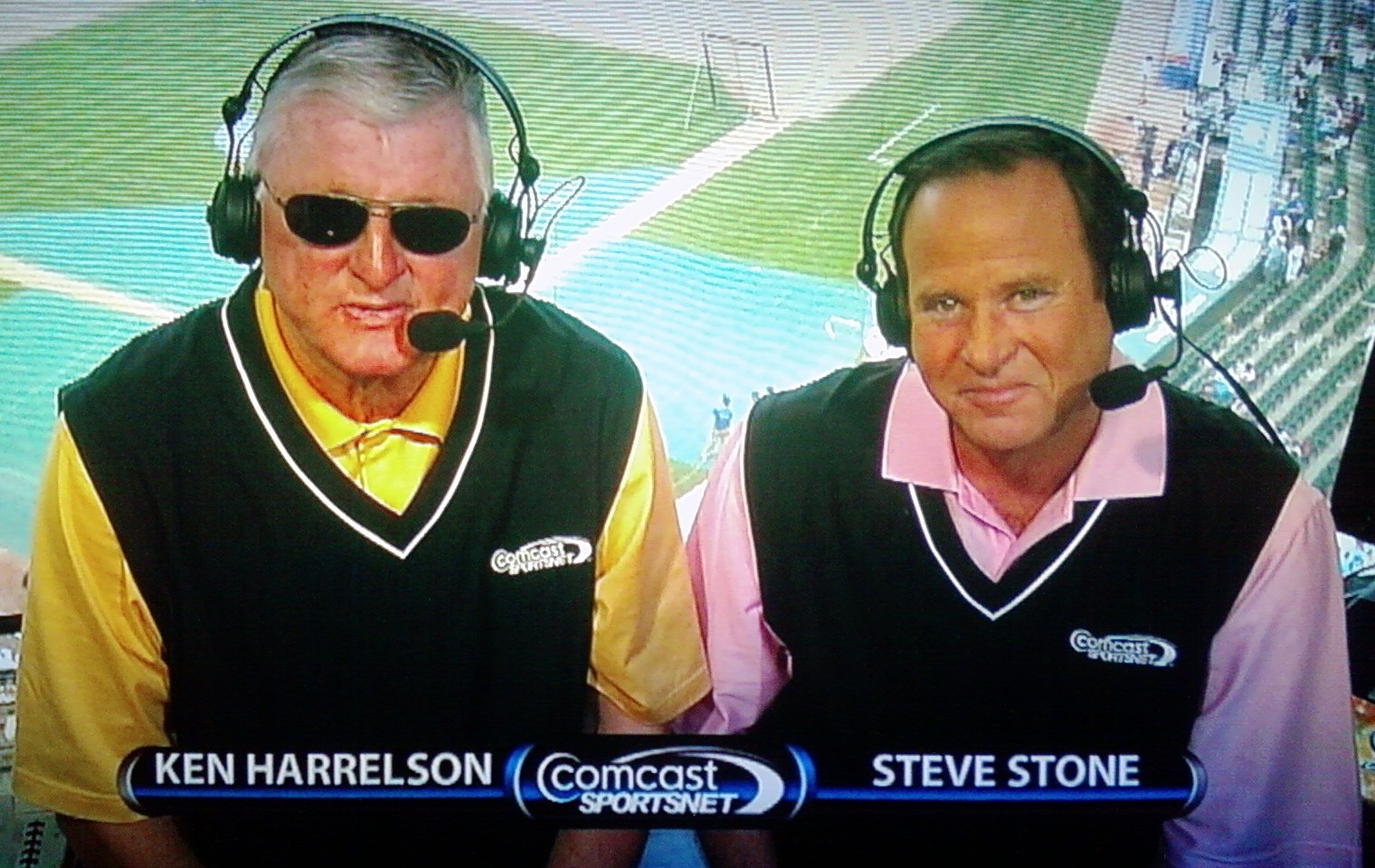 That’s not to say that they’re all good, and tonight’s Cubs-White Sox game provided a remarkably obvious example of how bad some announcers can be—especially when they’re frustrated with their team and overly invested in it to the point of becoming unprofessional. In this case, we have Ken “Hawk” Harrelson, who has called games for the South Siders for 20 seasons now. Most Sox fans I know tend to like Hawk’s unabashedly biased play-calling, which he often supplements with shameless cheerleading. This is all well and good, if that’s the kind of commentary you prefer. The flip side of that coin, though, is that he sometimes comes across as the worst kind of fan: the umpires are always out to get the Sox, the opposition sometimes makes lucky plays while the Sox are just downright talented, things like that. I’m actually fine with this; while I think I’d find it a little embarrassing if my team’s announcers were so partisan, Sox fans seem to like him and appreciate his style, and that’s cool with me. Just don’t flat-out lie about the game you’re calling, please.
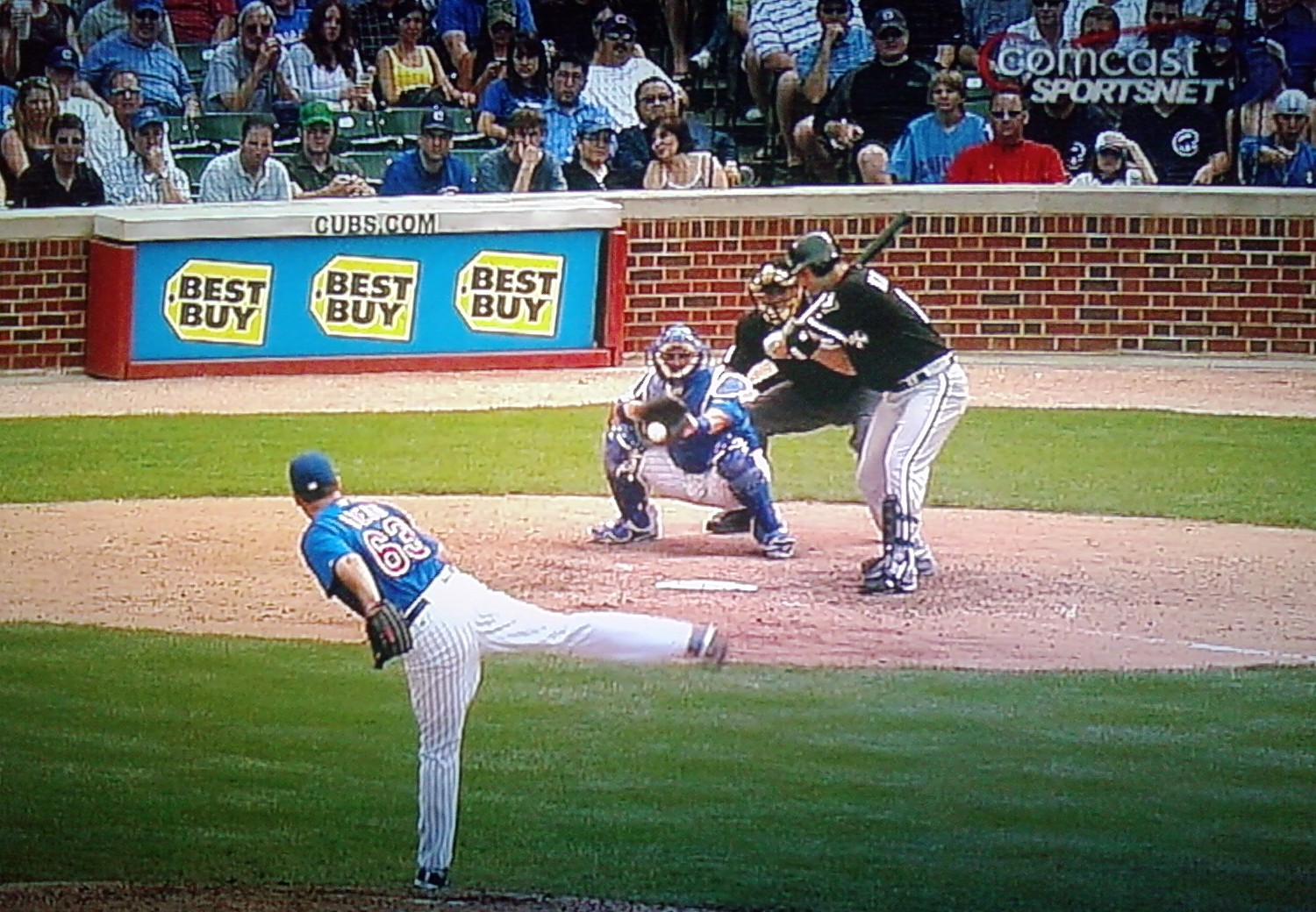
I’ll try to set the stage: it’s the bottom of the 8th inning, with the White Sox winning 5-1. The Cubs’ first batter (Micah Hoffpauir) reaches base on an error. The next batter is Alfonso Soriano, who with 2 strikes in the count gets this pitch:
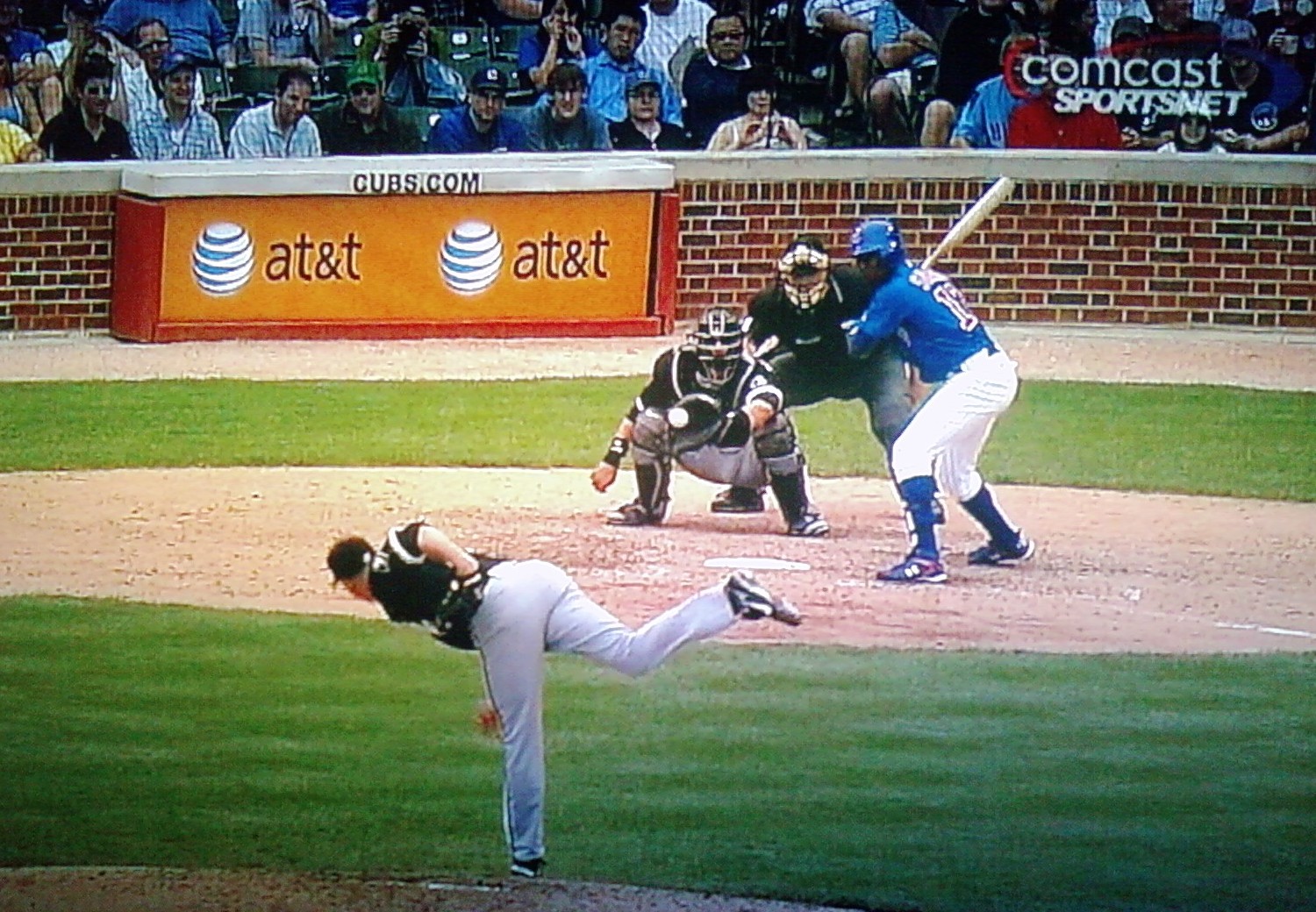
The Hawk is convinced that’s an obvious strike: “That ball had the plate. Had the outside edge of the corner.” The above picture is from the replay they showed, which Hawk was convinced reaffirmed his belief that it should’ve been a called third strike. His color man, Steve Stone (formerly the Cubs’ color commentator), tries to remain more diplomatic about it, but humors his partner just the same and agrees with him that it was probably a strike. Honestly, I think it’s one of those pitches that could’ve been called either way, but in the picture above I think it’s definitely more ball than strike. But whatever, the subjectivity of the umpire calling balls and strikes is part of the game, right?
On the next pitch, Soriano gets a base hit. The next two batters (Ryan Theriot and Milton Bradley) are retired, bringing the hot-streak-riding Derrek Lee to the plate with 2 outs, who proceeds to hit a 3-run homer. (Sub-rant: Why doesn’t MLB offer the ability to embed their videos?)
Next up is Geovany Soto, who also hits a home run, tying the game. Harrelson proceeds to lose it, repeatedly referring to the Sox giving up “4 unearned runs” to allow the Cubs to tie the game. For those of you keeping score, only the run scored by Hoffpauir was actually unearned, because he reached on an error. Soriano had a base hit, and Lee and Soto hit home runs, all of which are most decidedly earned runs on every score sheet except for Hawk’s. (I think he might’ve been trying to imply that Soriano reaching base was the result of an “error” on the home plate umpire, but he never clarified). So much for accurately reporting the events of the game. (Update: Apparently I am incorrect in my interpretation of how these runs should be scored; see the comments below for clarification.)
One of my biggest pet peeves with sports announcers in general is that they like to imply that if you changed the outcome of a single play, it is reasonable to assume that ensuing plays’ outcomes will remain unchanged. Hawk is happy to commit this commentator sin as well: he believes that had Soriano gotten out on what he felt should’ve been a called third strike, then Theriot and Bradley would’ve proceeded to get out in the same fashion as they actually did, and the inning would’ve been over without the Cubs scoring any runs, much less 4. As if them batting with an additional out, or with fewer runners on base, would be the same. Who’s to say the same pitches would’ve been thrown to them, with the same amount of success, their swings would’ve been the same, and all of the other little variables that contribute to how a single at-bat plays out would remain invariant? It’s nonsensical to think this way. (And in fact, I tend to believe that any time one endeavors to comment on what “would have” happened in almost any situation—sports or otherwise—they’re likely doing little more than demonstrating willful ignorance… Generalizations like “if that bomb had gone off, people would have died” aside, of course.)
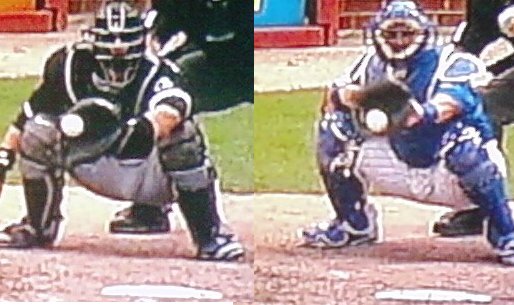
It doesn’t quite end there. In the top of the 9th inning, with Paul Konerko batting, he gets thrown “the same pitch” (according to Harrelson), which is this time called a strike.
Hawk can’t take it: “Why is that a strike on him, but it wasn’t a strike on Soriano?” he asks. I think the proof is in the pictures, which incidentally were taken from the same replays he was watching while continuing to whine about the supposedly-biased umpiring.
In the bottom of the 9th, Soriano—the beneficiary of the non-strike call that got the Cubs’ rally started in the first place—knocked in the game-winning run, just to rub it in. “5 to 1 lead going into the bottom of the 8th inning… 4 unearned runs… and they pitch to Soriano, and he gets the base hit,” Hawk summarizes.
There’s nothing wrong with being passionate about your team, even in the case of an announcer. In fact, this is one of the things that makes baseball unique: each team has their own set of commentators, who bring their own perspective to the games, and can typically assume that their audience consists largely of that team’s fan base. But going overboard by trying to frame the events of the game you’re calling in an untruthful manner, and then whining about it on top of that, isn’t something I can imagine anybody enjoying. (Stone, I should say, remained silent every time Hawk mentioned the “4 unearned runs,” presumably not wanting to get into an on-air fight with his incensed partner.)
At least he faithfully reported the outcome of the game: Cubs 6, White Sox 5. Whether the runs were earned or not.
Since I live on the west coast, I only rarely get to watch baseball games live. My team, the Chicago Cubs, plays most of their games at either 1:20pm or 7:05pm Central, and I’m rarely home from work in time to catch the beginning of even the later-starting games. I don’t really mind this, because watching on DVR delay means I can skip through commercials, and I’m typically busy enough at work that not spoiling the score (or outcome, in the case of earlier games) isn’t too difficult (although sometimes, when the sky is clear, I’ll listen to a day game on XM while at work, but that’s a different situation). The ideal goal is to have just the right amount of buffer built up so that you catch up to real time in the bottom of the ninth inning, having missed all of the commercials but seeing the game end live. I’m almost always a bit off from that, though, as I don’t usually begin watching a game until a couple of hours after it’s started.
Because of my viewing schedule, and my desire to remain ignorant of anything that’s happening with a particular game I’m going to watch until I’ve seen it for myself, I have my DirecTV +HD DVR set to record every Cubs game from the time it starts until 3 hours after it’s scheduled to end (that’s the max amount of additional recording time for a particular program that the software offers). This gives an allowance for rain delays and/or extra-innings games. Since I watch games every day, the wasted disk space on the DVR isn’t much of a problem—I just delete each game after I’ve finished watching it (which is usually while it’s still recording, due to the extra 3-hour record time).
This sounds like it’d be a good situation for someone like me, and it is, for the most part. The problem with it, though, is that it relies on heavy use of the DirecTV DVR software, which I have now decided is definitely the single worst piece of software I’ve ever had to use on a regular basis. Last year it made me miss Zambrano’s no-hitter, and while there hasn’t been anything quite that dire yet this year, it has nonetheless found other ways to annoy the ever-loving shit out of me on a way-too-frequent basis.
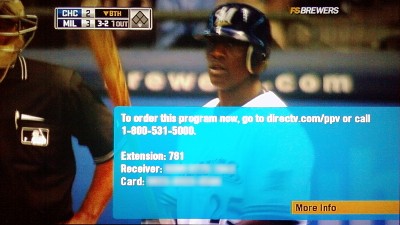
The most recent example involves the way DirecTV tries to be way too clever with their guide: despite the fact that they dedicate an entire channel—two, actually, for games that are available in both standard-definition and HD—to a game for a whole day, for some reason when the game actually ends they update their guide information so that the receiver/DVR knows the game is over. This results in the guide deciding that the channel is now devoted to a different, upcoming game, which, despite the fact that I have the MLB Extra Innings package and would be able to watch when it’s actually on, I am not yet authorized to receive. The result of this is that when I’m tuned to that channel—or in my case, watching DVR-delayed content from earlier on that channel—the DirecTV DVR decides that I am not authorized to watch it, and finds it necessary to repeatedly inform me of this… while I’m still watching the game.
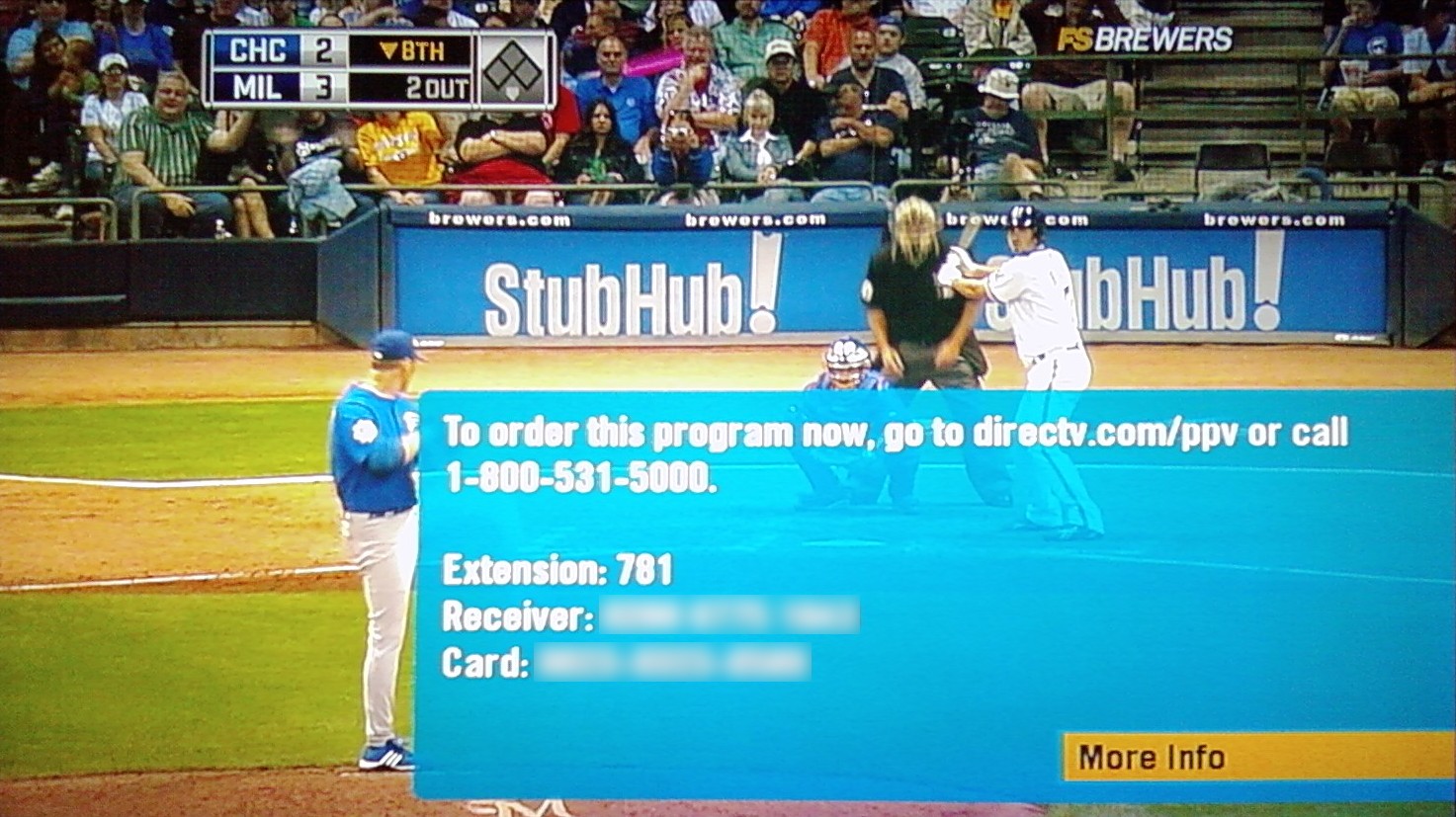
This is what last Friday night’s Cubs-Brewers game looked like for me during the final few innings (click to enlarge)
So I get this annoying box popping up, occupying over a quarter of the screen, at random intervals and for seemingly-random lengths of time… and it doesn’t respond to my remote’s “exit” button. I can select the “More Info” box, but all that does is obscure the screen even more, until I hit “exit,” at which point the info box disappears for a few seconds before popping up again. This happens from a point shortly after the game ends (I think it’s a half hour) until I’m done watching it.
An illustrative timeline might clarify, if my description has been confusing at all:

What’s really odd is that this doesn’t always happen. From my casual observations, it seems to only come up when I’m more than a certain amount of time behind real time. For example, call the difference in time between when the game starts and when I begin watching it “interval A,” and the difference in time between when it ends and when the guide data changes “interval B.” I think that if interval A is greater than interval B, then at “interval B” time after the end of the game, the “To order this program now…” box will begin displaying on the screen. (The corresponding guide data change would be, in this instance, from “Cubs @ Brewers [HD]” to “Upcoming: Cardinals at Reds.”)
The one solution I’ve found is as follows: once the box starts being displayed, I have to stop watching the game and change the channel to something normal (i.e., not part of a sports package). I then have to stop the recording, and then resume watching the recorded game. I’m always a little nervous to do this, though, because I’m not positive that my theory of what causes this to happen is correct, and I don’t want to stop the recording only to find that I’ve caused myself to miss the end of the game. And it doesn’t always do the trick, anyway. At any rate, it’s really not something I should have to contend with in the first place, and the fact that it’s just the result of sloppy programming on DirecTV’s part only makes it that much more annoying when I do.